
Summer 2001
The turning-point encounter
During a Lega Missionaria Studenti camp in Sighetu Marmației, Transylvania, Father Massimo Nevola SJ and Father Vitangelo Denora SJ — together with the young volunteers — meet a small group of children sleeping in a city dump. From that encounter comes the desire to give a home and a family to those who have neither roof nor affection.
2001-2002
Field study and discernment
A year of research and listening: the closing of state orphanages and the gap it left between street, exploitation, and violence. Dialogue with Romanian institutions, and the first design of the structures, within the Jesuit and LMS network.
August 2002
'Il Quadrifoglio' is founded
The Italian-Romanian association 'Il Quadrifoglio' is registered in both countries, with mixed governance and chaired by Massimo Nevola SJ. The legal framework is Romanian, where the family homes operate.
Personal motivation
Sighet as a place of consolation
In the volunteer narrative, Sighet and the memory of Elie Wiesel become a deep personal driver to build a stable, long-term presence.
Summer camps
Training and service on the ground
Camps include free Italian/English courses, support in municipal facilities, and educational presence with children facing severe hardship.
Operational shift
From shock to structural response
After seeing children sleeping on the street, the group reframed its mission and chose a continuous concrete response: family homes.
2003-2005
The first two family homes
The severity of the conditions encountered prompts the association to open two homes at once instead of one. The first family homes in Sighet take shape, run by local Romanian staff, with a resident couple as a stable emotional core.
August 2007
Third family home fully operational
After four years of work and good results in the first two homes, the third structure enters full operation. Together they welcome 27 children (10 + 10 + 7), supported by an entirely local staff.
2008
Four objectives, one direction
The project is structured around four interconnected goals: survival of at-risk children, human and educational development, cultural growth, and pathways to work and self-sufficiency. The partner network grows: LMS, Society of Jesus, Popica Onlus, Aiutaci a Vivere, Fondazione Magis, Protecția Copilor.
2008-2010
Model consolidation
With three homes operating, the project enters a stabilization phase: structured educational environments rather than emergency response. Pedagogical teams, psychological support, and collaboration with schools and local services are reinforced.
Summer camps (continuous)
A bridge between Italy and Romania
Summer camps became continuous and formative: volunteer training, constant educational presence, and emotional continuity for children through recurring yearly relationships.
Video 1 - Project origin and growth
Caricamento
Video 2 - Story from a volunteer's perspective
Caricamento
Summer 2008 — Volunteers arrive in Sighet
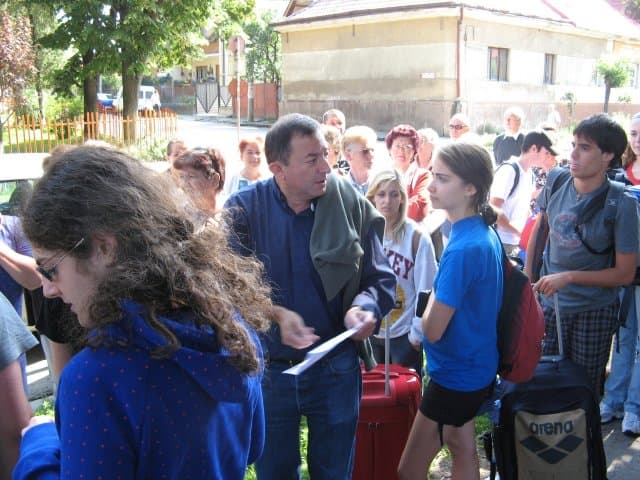
Summer 2008: the volunteers' arrival for the missionary, educational, and social camp, with Father Massimo Nevola leading the group.
Video 3 - Journey testimony
Caricamento
Quadrifoglio project supporting Ukrainian refugees
Il Mediano - March 10, 2022
Coverage of Quadrifoglio's activation for hosting Ukrainian refugees in Sighet, including urgent fundraising and local coordination.
Open full article→
Invitation in Rome
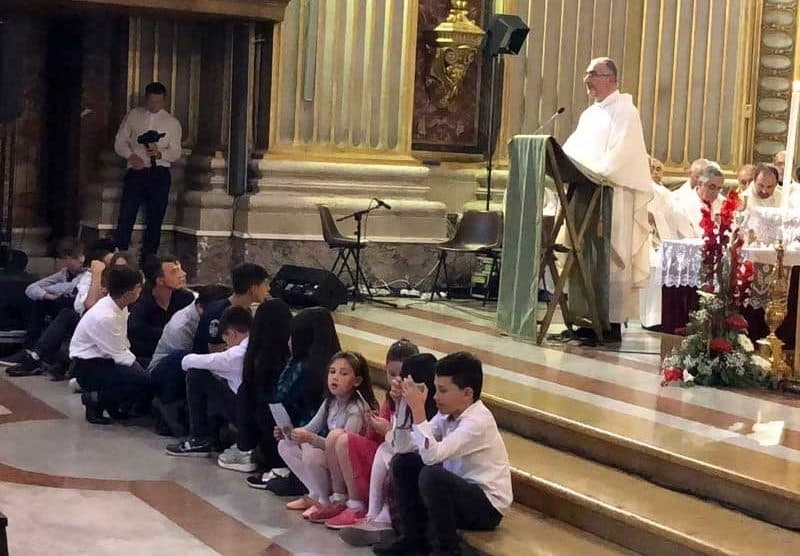
Photo documentation connected to the project's recognition path and the network built between Sighet and Rome.
2010-2015
From protection to autonomy
As the first children grew up, the focus expanded toward adult-life preparation: pathways to work, skills development, and personal responsibility.
Structural transformation
Fewer homes, stronger sustainability
Over time, the number of family homes was progressively reduced. The shift favored educational quality and long-term sustainability over higher numbers.
2015-2020
Relationship at the center
The project concentrated on smaller cores, stable parent-like figures, and individualized support: a real home environment rather than an institutional structure.
Educational model
Family home as emotional core
The project introduces a family-based model with parent figures and educators, focused on relational growth, not only material support.
Support network
Small contributions, real impact
Progress continues through a wide network of friends and donors: ordinary giving and extraordinary help that sustain long-term continuity.
2018
Twenty years of journey and recognition in Rome
More than twenty years after Padre Carlo Maria Vitangelo Denora first arrived in Sighet, the project confirms educational outcomes: former children now work, study, and build autonomy. In October, a delegation from Sighet joins a significant monastic moment in Rome.
2022
Ukrainian refugee emergency response
In border-city Sighet, the project mobilized to host Ukrainian refugees with operational setup, emergency fundraising, and Jesuit network coordination.
Ongoing vision
A long-term sign of change
The team sees real change as a multi-year path, where each transformed story confirms the mission: recovery, dignity, and future.
2026
Erasmus+ educational exchange in Palermo
Teenagers from Regele Ferdinand High School and Casa Famiglia Il Quadrifoglio, currently achieving strong school results, are taking part in an educational exchange program in Palermo through Erasmus+.
Today
One home, one real family
Today the project centers on one main family home: less visible, but deeper. A stable household supports around 10 children with educational and psychological care.